A booking for a transfer or multi-day from Tbilisi has a simple vehicle question: S-Class or V-Class? Most briefs default to S-Class because the S-Class is the photograph the brand sells. Most defaults are right. Some defaults cost the guest a day they did not need to lose.
The shift happens at a specific math. Two travelers and three pieces of luggage fit in an S-Class. Four travelers and ten pieces do not. The trip where that shift starts to bite is the trip where the right answer is a V-Class — the seven-seat car in the fleet. Here is how to read the math, and the times when two S-Classes are still the better call.
The luggage math
The brochure for a Mercedes-Maybach S-Class says the trunk holds 550 litres. That number is true and useless. The practical capacity for guests is two full-sized suitcases (28 inch / 75cm) and one carry-on. Three full-sized suitcases is a wedge that the rear shelf cannot hide; four is not possible. Add a duffel for a guest’s coat, a small camera bag, or a child’s bag and the calculation tightens further.
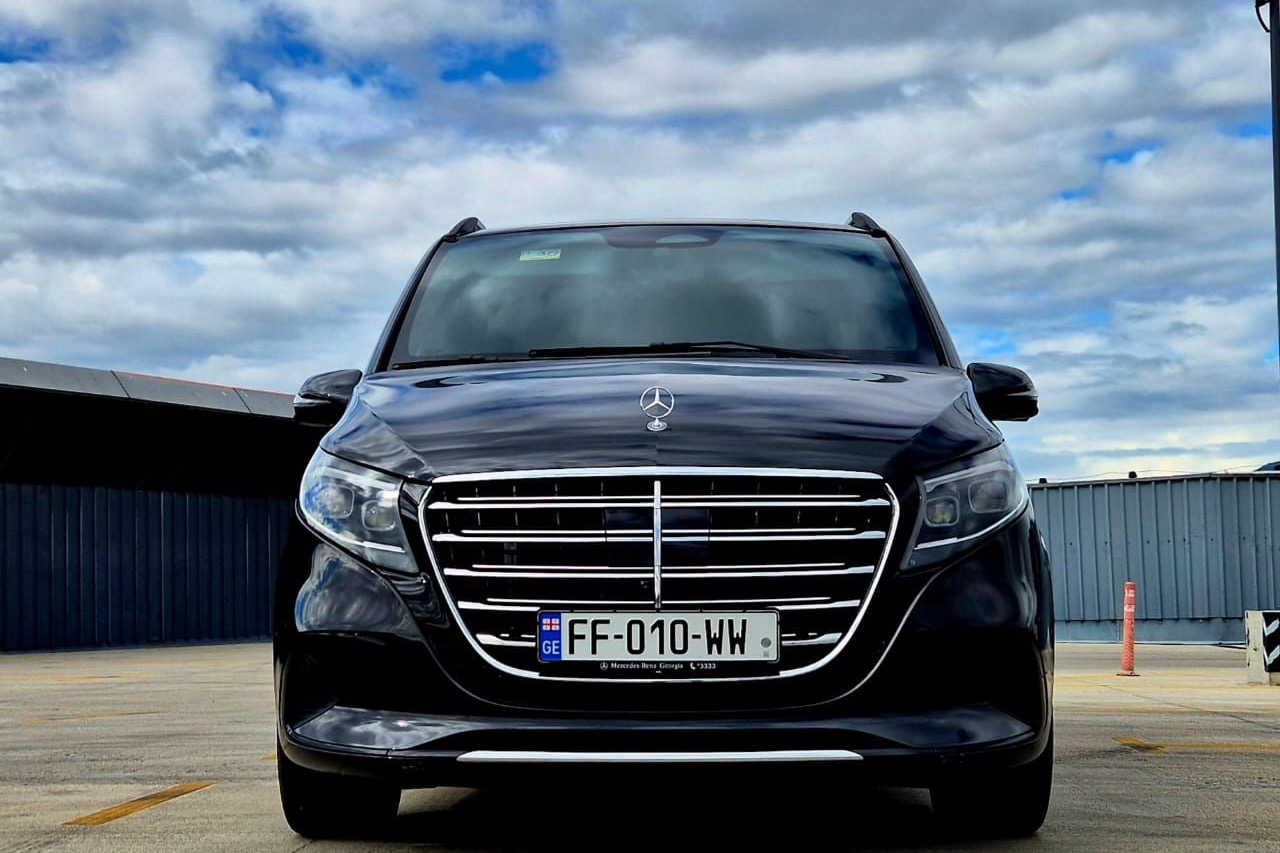
The V-Class W447 has a trunk that is genuinely large. Six full-sized suitcases fit behind the rear seats with the cargo cover off; with the cover and a strap, seven. We have carried eight on a four-passenger family booking, with two bags in the front passenger footwell. The math holds.
The luggage tipping point is the third large suitcase. At three large bags the S-Class is at its real limit; at four large bags the V-Class is the right answer. For most guests the cleanest test is the question: how many full-sized suitcases plus carry-ons total? Three large is the line.
Where the V-Class wins
Families. Two adults plus two children with a stroller and family luggage is the classic V-Class booking. The captain’s chair layout in the middle row lets the children face the parents in the rear, which makes the long Kakheti or Kazbegi day workable for a child. The sliding door (rather than a swing-out hinged door) is easier to load a sleeping child into.
Mid-size corporate groups. Three to five executives on the same trip with carry-on bags fit comfortably with room for laptop work between them. The optional fold-out table in the middle row turns the cabin into a meeting space. We have run board meetings between Tbilisi and Telavi with the V-Class as a moving room — the corporate chauffeur version of a working day; the documents got reviewed and the day was not lost.
Ski and outdoor equipment. Skis, snowboards, photography tripods, fishing rods. None of these fit in an S-Class trunk without compromise; all fit in the V-Class with room. Guests heading to Gudauri in winter or to Svaneti for a photography week are V-Class trips.
Multi-city circuits with luggage. If the guest is moving from Tbilisi to Telavi to Kutaisi and back over a week, the V-Class holds everything between stops without unloading bags into hotel rooms each night. The S-Class on the same circuit forces a luggage-up-luggage-down at each hotel.
The interior trade
The V-Class is not a more spacious S-Class. It is a different cabin with different trade-offs.
Captain’s chairs. Two seats in the middle row, each individually adjustable, facing forward or backward. The backward-facing configuration around a fold-out table is the meeting layout. The forward-facing configuration is the family-with-children layout.
Rear bench. Three seats across at the back. Comfortable for a third row of adults but not as plush as the captain’s chairs. For four-passenger bookings, the bench usually carries luggage or the children’s bags; for five-plus passenger bookings, it carries passengers.
Two screens. Not embedded in the seatbacks the way the S-Class has them, but available on swivel mounts mounted to the cabin roof. We default to having them disabled unless the guest asks for them; the V-Class works better as a quiet cabin than as a screen-on cabin.
Sliding doors. Both sides. The driver opens them on arrival and departure; guests do not handle them. The sliding action is slow and quiet, which works against the hotel porte-cochère habit of fast in-and-out. Allow ten seconds longer per door at hotel arrivals.
No mid-cabin partition. Unlike the S-Class, where the rear cabin is acoustically separate from the front, the V-Class is one continuous cabin. Conversations carry. For sensitive corporate work, brief us in advance and we move the driver to the partner vehicle and use the V-Class as a passenger-driver-quiet space.
When two S-Classes still beat one V
The V-Class is the right answer for one booking with four-plus passengers. It is not always the right answer for two-vehicle bookings of the same total size.
Different drop locations. A V-Class can only be in one place at a time. If the guest party is splitting between two hotels, or between a hotel and an event venue, two S-Classes are the right call. The cost is slightly higher; the flexibility is worth it.
Different schedules within a group. A corporate group that wants three executives at a meeting at 9am and two more arriving at 11am is a two-vehicle booking. A V-Class forces all five to arrive together.
Route splits. Guests planning to do Kakheti during the day and a separate party planning to do the city are two bookings. The V-Class assumes a single party with a single route.
Family with two adults and one child. This is an S-Class trip. The V-Class is overkill, costs more, and the cabin feels under-occupied. The S-Class is the right car.
Multi-day with a V-Class
For multi-day routes with the V-Class, two notes.
Same driver. We rotate drivers on multi-day routes longer than three days, and the V-Class is no exception. The benefit of the V-Class on multi-day is the consistent cabin; the same driver makes the cabin a continued environment, not a series of new ones.
Fuel and refill. The V-Class is a diesel and is fuel-efficient for its size, but the tank is larger than the S-Class and refuels are less frequent. On Svaneti runs (the most fuel-tight route we do), the V-Class is the better choice partly because of this.
Mountain roads
The V-Class on mountain roads asks for more care than the S-Class. Two things.
Width. The V-Class is slightly wider than the S-Class. On the narrowest roads (the inner Ushguli road, the Lentekhi pass, some tight switchbacks above Mestia), the V-Class is at the upper limit. On the Mestia main road, the Military Highway, and the Sighnaghi loop, width is not an issue.
Body roll. The higher centre of gravity means the V-Class rolls in tight corners more than the S-Class. For passengers prone to motion sickness, this matters. We adjust speeds; the day on the road may be ten percent longer.
Snow and ice. The V-Class on winter mountain roads is acceptable but more cautious than the S-Class. For winter Kazbegi or Gudauri trips with a V-Class — and the Military Highway outside high season is the same road — we add snow chains to the vehicle as standard.
The booking note
The vehicle question is part of the booking brief, the multi-day brief, and the airport brief alike. If the brief is silent, we default to S-Class for one to two passengers and V-Class for four-plus passengers. Three passengers is the judgment-call number; the right answer depends on luggage and route.
For first-time concierges working with us, the question we ask back if the brief is silent is luggage count. Three large bags or fewer: S-Class. Four or more: V-Class. Specify route preferences (mountain vs city, single-route vs multi-stop) and we will confirm the vehicle in the reply.
Where the party arrives at a hotel rather than a house, the Tbilisi hotels we drive to most notes which porte-cochères take a V-Class comfortably. Email bookings@soitblack.com or send us the luggage count.