The line that gets repeated is that Georgia has been making wine for 8,000 years. The line that gets repeated next is that Alaverdi Monastery has been making wine continuously since the 11th century. Both lines are doing some work. One is a UNESCO claim that survives scrutiny; the other is monastery marketing with a partly-true core. For a guest who cares enough to ask, the difference is the point of the visit.
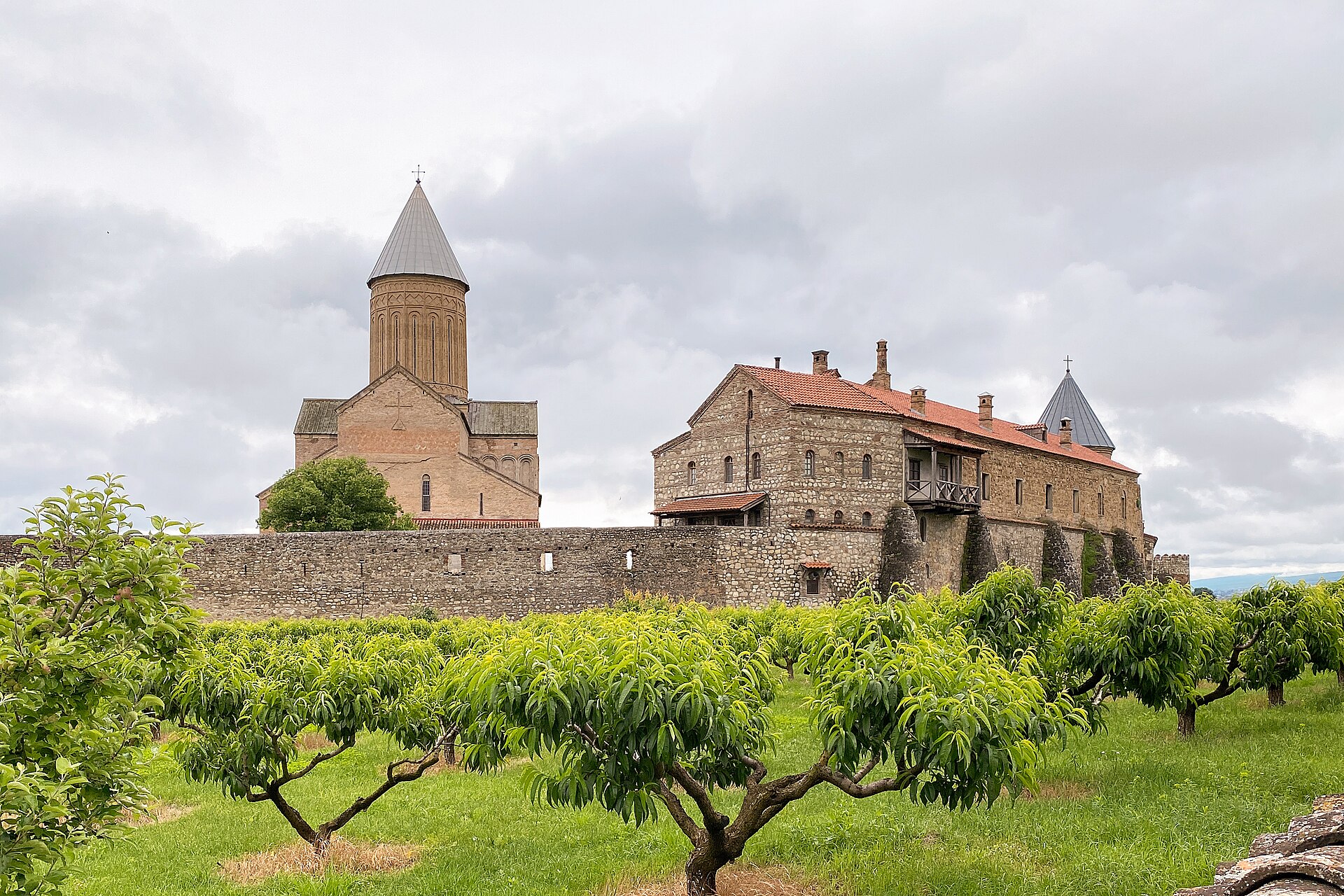
Alaverdi Cathedral sits twenty kilometres north of Telavi, in the Alazani valley, with the wall of the Caucasus directly behind it. The cathedral itself is one of the tallest medieval churches in Georgia, built around 1020 under King Kvirike III. The cellar beneath the monastic complex is what the wine-curious guest is actually coming for, and it is the stop we build a Kakheti day by private chauffeur around when the ask is history rather than tasting rooms.
The 8,000-year claim, decoded
The number comes from a specific archaeological site: Shulaveris-Gora, fifty kilometres south of Tbilisi, where excavations found qvevri shards with grape residue dating to roughly 6,000 BCE. UNESCO inscribed the qvevri method on its Intangible Cultural Heritage list in 2013. The “8,000 years” is real in the sense that grape fermentation in clay vessels in the territory now called Georgia is verifiable to that depth.
What it does not mean: that the line is unbroken, that Alaverdi specifically goes back that far, or that what you taste in a modern qvevri is identical to what was poured in a Neolithic settlement. None of those claims survive a careful read.
The honest version: Georgia has the oldest archaeologically-documented wine-making region in the world, and how that reputation is now travelling is a separate story. The method has been continuously practised in Kakheti within living memory and across many generations before that. Alaverdi sits inside that tradition. That is the version worth telling a guest.
What Alaverdi actually is
A working monastery, currently under the Bishop of Alaverdi, with a small community of monks. The cellar, the marani, is part of the monastic complex. Wine production was suspended under Soviet rule and revived in the early 2000s. The revival was significant: the monks rebuilt the qvevri, replanted vineyards on monastery land, and began producing wines that now sit on serious restaurant lists across Tbilisi and abroad.
The wine is made by monks, with hired help during harvest. The grapes are estate fruit from the monastery’s own land. The qvevri are buried in the marani, a low cellar that stays at roughly 12 degrees year-round. Skin contact for the white wines (the amber style, sometimes called orange) runs five to six months. The reds are conventional in technique but still made in qvevri.
There is no tasting room with a price list. There is a cellar, a corridor of glassed-in qvevri lids in the floor, and whichever monk or steward is on duty. The character of the visit shifts depending on who walks you through.
The qvevri method without the romance
A qvevri is a clay vessel, egg-shaped, somewhere between 800 and 2,000 litres in volume, buried up to the lid in the ground. The clay is sealed inside with beeswax. The grapes are pressed and poured in whole: juice, skins, stems for the most traditional wines, sometimes destemmed for cleaner profiles. The qvevri is sealed and fermentation starts naturally with the yeasts on the skins.
For white wines, the long skin contact does three things. It pulls colour out (which is why the wines are amber). It pulls tannin (which is why the wines have grip a conventional white doesn’t). And it stabilises the wine biologically, which is why qvevri whites are made without sulphur or filtration and still last.
For red wines, the qvevri does less work — the wine would be similar in a barrel. The case for qvevri reds is mostly tradition.
The romance around qvevri is real but it is also marketing. The technical case is real and worth the explanation, which is what a guest who came for the visit actually wants.
How a visit works
You arrive at the cathedral gate. The cathedral itself is the first part of the visit; it is one of the older surviving cruciform churches in Georgia, the dome rebuilt several times across nine hundred years. Walk it slowly. The interior frescoes are partial, the architecture is the point.
From the cathedral, the monk or guide takes you to the marani. The cellar is not large. Twelve to sixteen qvevri sit under the floor with glass plates above each so you can see the wine fermenting. The tasting is poured from samples, sometimes from the qvevri directly, in small clay or glass bowls.
Three or four wines is the usual flight: a Rkatsiteli amber, a Mtsvane amber, a Saperavi red, sometimes a blend. The pours are not large. There is no buy-and-leave gift shop in the sense a Napa winery would have; there is a small wooden table where you can buy bottles to take. The bottles travel well; many guests later regret not taking more.
The visit ends in the courtyard. There is no formal sit-down meal at Alaverdi. For the meal, plan to drive on to a winery in Akhmeta or back to the hotel; the wine roads route covers the cellars worth the detour.
Pairing with Ikalto and the David Gareja line
The deepest wine-history day in Kakheti is Alaverdi in the morning and Ikalto in the afternoon. Ikalto Monastery is ten kilometres further, founded in the sixth century. It contains the ruins of an academy where Shota Rustaveli is said to have studied, and an older monastic marani with qvevri visible in the open. Where Alaverdi is the living modern cellar, Ikalto is the archaeological version. Together they tell the long story.
A longer day adds David Gareja, the cave-monastery complex on the Azerbaijani border south of Telavi. This is a different kind of trip — three hours of driving each way, no wine, the spiritual geography of an empty steppe. It does not pair well with Alaverdi on the same day. Save it for a separate visit, or attach it to a return-to-Tbilisi route.
Driving and dress
Alaverdi is twenty kilometres north of Telavi on a paved road that follows the Alazani’s western edge. From Tbilisi door-to-door is roughly two hours via the Gombori Pass; from a Telavi base, twenty-five minutes.
The gate to the monastic complex opens at 9am and closes at 6pm. The cellar visit is best in the morning — light is right for the courtyard, the steward has time, the courtyard is quiet. Aim to arrive between 10 and 11 — earlier still during rtveli, the six harvest weeks.
Dress is a working monastery, not a museum. Women cover their shoulders and their heads inside the cathedral (a scarf at the door works). Men remove hats. Shorts are not acceptable. We carry spare scarves in every car we run for guests who didn’t pack one.
Photography inside the cathedral is restricted; outside is fine. Inside the marani, the steward will tell you what is and isn’t allowed; defer.
The booking note
Visits to the cellar are not formally bookable in the way a commercial winery would be. The monastery accepts visitors during opening hours; for tasting groups larger than four, a phone call ahead through us is usual courtesy. The wines themselves can also be ordered in advance for shipment from the Alaverdi shop in Tbilisi.
For a guest interested in Georgian wine at the level of history rather than the level of consumption, this is the half-day to put first. Guests who make this the anchor of a longer stay usually pair it with Sighnaghi in a day on the way back to Tbilisi. Email bookings@soitblack.com or send us the preferred date and the size of the party.