Tbilisi is named for its hot water. The Georgian word tbili means warm; the city is the warm-water place. The sulfur springs run under the southern edge of the old town at temperatures between 30 and 44 degrees Celsius, and have been used as public baths for at least 1,500 years. The current cluster of bath houses dates mostly to the 17th-19th centuries, with a few earlier foundations.
For a guest staying in Tbilisi for more than two days — or parked in the city between legs of a multi-day booking — the baths are the closest thing the city has to a single experience that explains the place. The version most concierges sell goes like this: drop the guest at the blue-tile facade, two hours later pick them up. That version usually picks the wrong bath house, gets the booking format wrong, and skips the etiquette piece that makes the visit work.
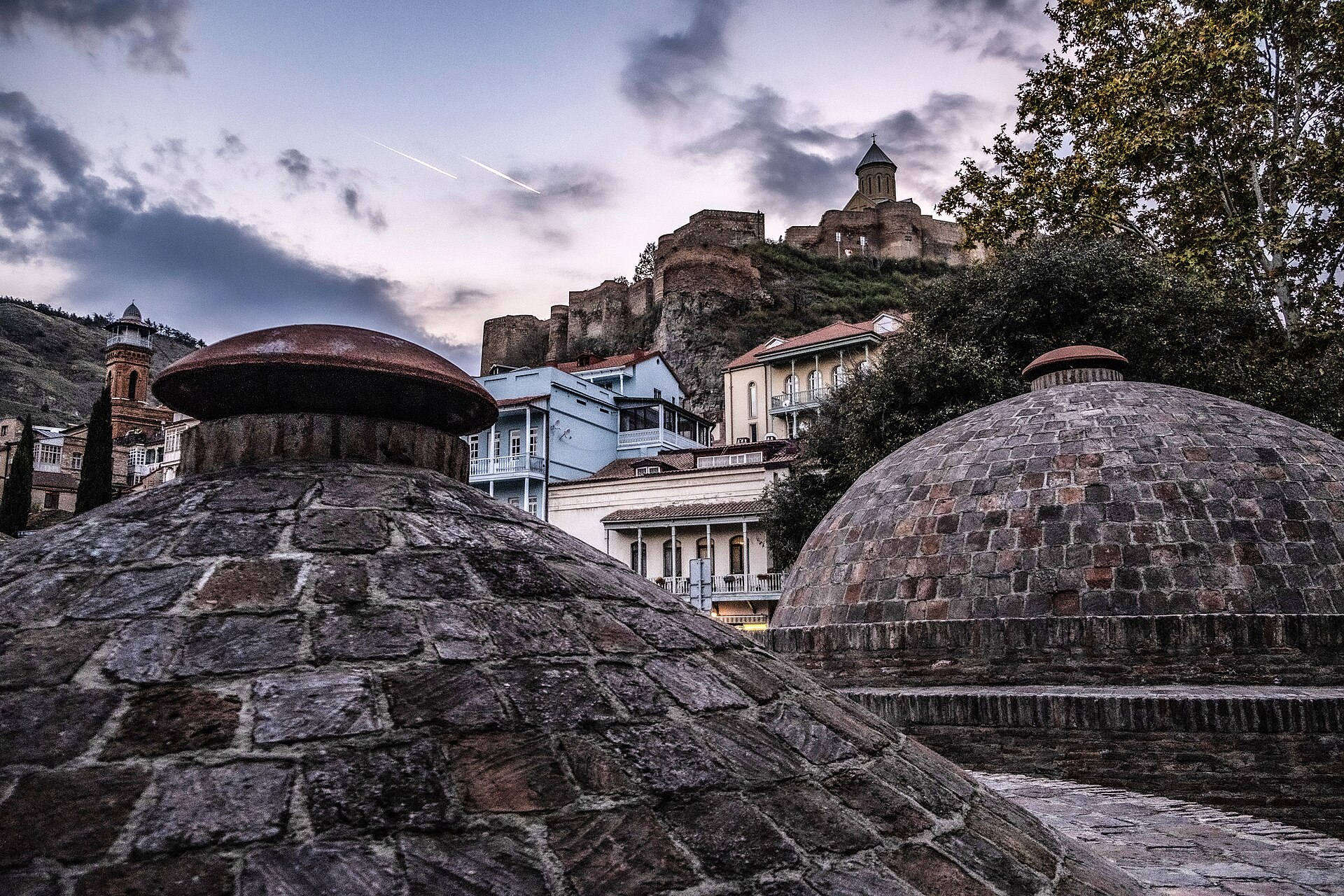
The geology
The water rises naturally from springs in the valley below Narikala fortress. The temperature varies by spring; the high-30s are typical for the bath houses’ supply. The water contains hydrogen sulfide, which is the source of the mineral feel and the slight smell that guests notice immediately. Medical claims about sulfur water are contested in the modern literature; the relevant claim for a guest visit is that the water is mineral-rich and warm, and that being in it for thirty minutes is genuinely relaxing for most people.
The springs feed six historical bath houses arranged in a small valley between the old town and the Persian quarter. The valley itself is twenty minutes’ walk from Sioni Cathedral, at the southern end of the old-town spine; in driving terms it is a five-minute trip from anywhere in the central old town.
The six houses
The six are not interchangeable. Each has a different layout, a different clientele, and a different price tier. Match the guest to the house.
Chreli Abano (Orbeliani Baths). This is the one with the blue-tile facade — the one that ends up in every Tbilisi photograph. The interior is the most ornate of the six, the rooms the most decorative. It is also the most-photographed, the most-photographed-from-inside, and the most expensive. Useful for guests who want the photograph as much as the bath. Private rooms only.
Royal Baths (Samepo Abano). The largest and most professionally-run of the six. Multiple private rooms at different sizes, a large public pool, and a separate spa wing. Used by us as the default for guests who want the bath without the spectacle.
Bath No.5 (Bani Number 5). A smaller, less touristed house. The clientele is more local; the interior is older and less restored. The right call for a guest who specifically wants the unpolished version.
Bakhmaro Baths. Mid-tier. The water is the same; the room finishes are simpler than Chreli, more polished than No.5. We use it for guests who want a private room without the price of Chreli.
Mirzaani Baths. A boutique-end option. Smaller than the others, with a fitness studio attached. Used by repeat guests and by Tbilisi residents.
Gulo Baths. Often unstaffed at certain hours; check before sending a guest. The smallest of the six, and the one we send guests to only with prior coordination.
The default recommendation for a first-time visitor: Royal Baths, private room with an hour booking. If the guest specifically wants the blue-tile facade as a photo: Chreli, private room.
Private rooms vs public pools
Two formats. They are different visits.
Private rooms. A walled room with its own marble bath, hot water on a tap, a cold water rinse, a slab for the kisi (scrub) procedure, and a small dressing area. The price varies by house and time of day; reckon 50-80 GEL per person per hour for mid-tier, 120-200 GEL for Chreli at peak. Two hours is the standard booking; we recommend ninety minutes for most guests, plus a fifteen-minute rest after.
Public pools. A larger pool shared with other guests. Cheaper, more authentic in a way some guests prefer, less suitable for guests who want privacy. Gender-segregated. Price is roughly 25-40 GEL per person.
Most guests want private. Couples should book a private room together; the public pools are not co-ed. Hotels in the higher-tier range often quietly assume a private room and don’t mention the public option exists.
The kisi
The kisi (sometimes kese or kisiyel) is the traditional Tbilisi scrubbing procedure, originally Persian. A bath attendant, often called a meqise or “scrubber,” washes the guest with a coarse mitten and a hard soap, removes a layer of dead skin, follows with a soap massage, and ends with a rinse. The procedure takes twenty minutes and is the most distinctive part of the visit. It is not optional in the cultural sense — most local guests would not visit the baths without it. It is optional in the modern booking sense; the guest can opt out.
What to know:
- The kisi is rougher than a Western spa scrub. First-time guests are sometimes startled.
- The attendant is the same gender as the guest. Couples can request the same room but separate attendants.
- The cost runs 30-50 GEL on top of the room rate, paid at the end. Tipping (10 GEL) is appropriate for good service.
- Speak up about pressure if it is too much. The standard pressure is firmer than most spa guests expect.
For first-time visitors, we strongly recommend including the kisi. The bath without it is just hot water in a marble room; the kisi is the half that makes it Georgian.
Hours, dress, and what the hotel won’t tell you
Hours. Most houses open 9am and close midnight; some run later on Fridays and Saturdays. The quietest visit is mid-morning (10-11am) on a weekday. The busiest is evening (7-10pm) on Friday and Saturday. We avoid Saturday afternoons.
Dress. Bring nothing. The bath provides slippers, a small disposable towel, and shower gel. Guests bring their own swimwear if they want to wear something in the room (not required — most rooms are private and most local guests wear nothing). Bring a small bottle of water to drink during; the air in the room is humid.
Showering before. Yes, briefly. There is a small rinse area in every private room.
Phones. Allowed in dressing areas, not in the bath room itself. The humidity is bad for electronics.
Tipping. 5-10 GEL to the attendant, 10 GEL for a good kisi. Cash, at the end.
Eating before. Light only. Do not go to the baths immediately after a heavy Georgian lunch.
Drinking before. No. Wine and sulfur are a bad combination; we have driven guests home faint more than once.
Driving notes
The Abanotubani valley is reached from Sioni Square via the small cross-street that descends into it. We drop guests at the upper edge of the valley (there is a designated drop-off) and wait with the car at the parking area opposite the Meidan basement bridge. Pickup is the same; we time it for the guest’s exit window plus ten minutes.
Two complications. First, the valley itself is small; cars cannot stop inside it for more than a moment. Second, the parking situation around Meidan is variable in the evening; for late-evening bath bookings, we sometimes ask the guest to walk the 200 metres up to the bridge for pickup.
The booking note
For a guest visiting the baths for the first time, please specify on the booking brief: house preference (Royal default, Chreli if photo matters), private room or public pool (private default), kisi included or not (recommended yes for first time), and the visit time (mid-morning weekday recommended). We book the room, coordinate the kisi attendant, and arrange the drop-off and pickup with timing matched to the booking.
From most of the hotels we drive to the valley is a five-minute trip. Email bookings@soitblack.com or send us the preferred house and hour.