Guests who ask for “the old town” of Tbilisi get pointed in three different directions by three different concierges. Some send them to Freedom Square. Some to the sulfur baths. Some to Meidan. All three are right, in the sense that the medieval city stretched across all of them. None is the answer that produces a good one-hour walk.
The answer that produces the walk is a single street called Kote Afkhazi. It runs roughly 500 metres from Sioni Cathedral north to the line that becomes Erekle II. Walking it slowly is the version of the old town that earns the time. The map versions of the old town include too much and lose the spine.
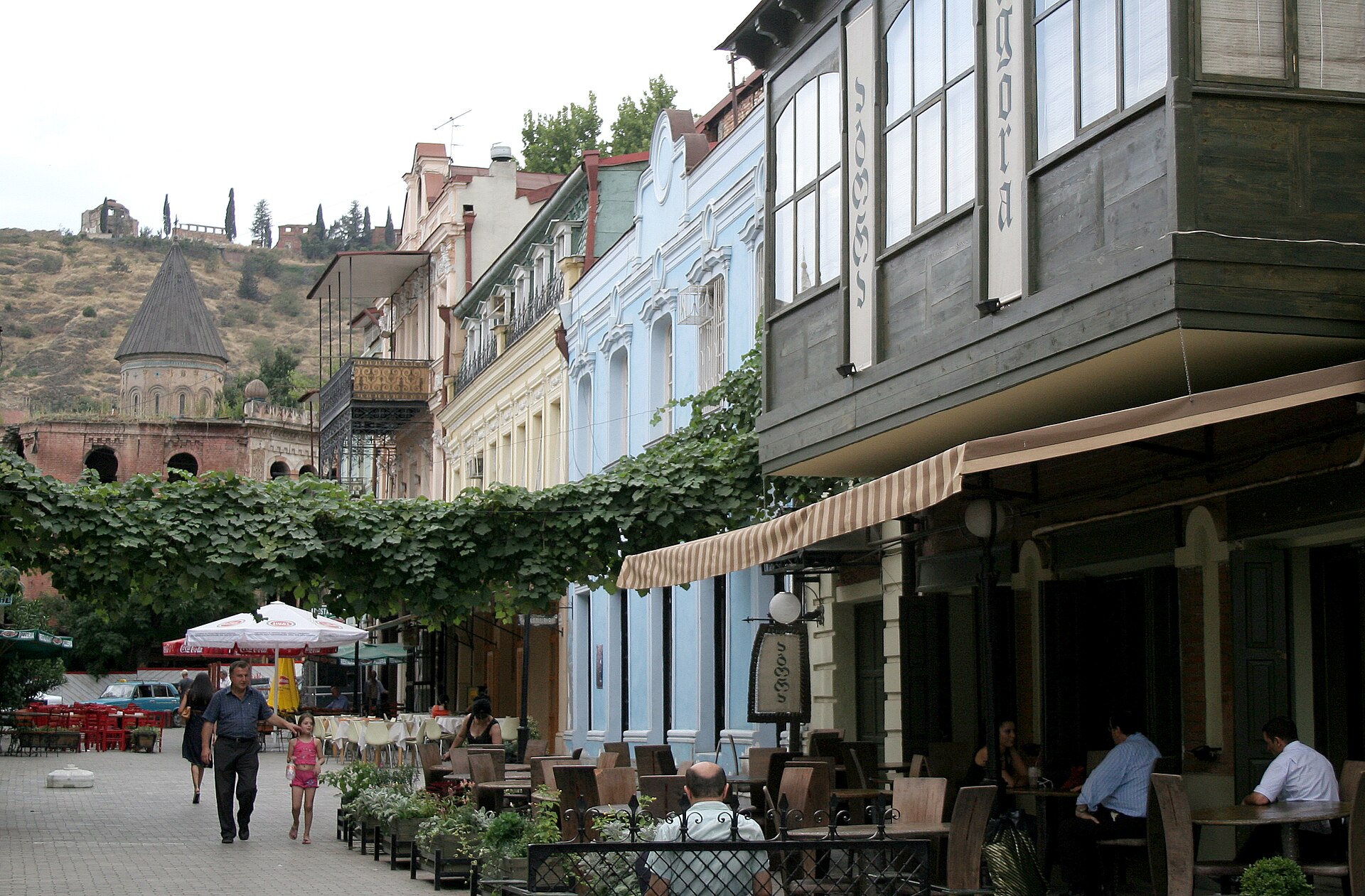
The map versus the city
The Tbilisi tourist map outlines the old town as a triangle. Freedom Square at the top, the Mtkvari river on the east, the Narikala fortress on the south. Inside the triangle are old residential streets, two cathedrals, the sulfur baths, the Meidan Bazaar square, and the funicular up the hillside. It is roughly a square kilometre. Walking the whole triangle takes three hours and is not a coherent experience.
The city itself works differently. The medieval centre had a spine — a street that ran north-south on the river side of the hill, with the cathedrals along it, the residential houses behind it, and the bazaar at its base. That spine is still there. It is called Kote Afkhazi now (after the noble who lived on it). Walking the spine is the trip; the rest of the triangle is what you see from the spine, not what you walk.
A guest with one hour gets walked from Sioni Cathedral north along Kote Afkhazi to Erekle II. A guest with two hours adds the descent to the Meidan and the climb to Narikala. A guest with three hours adds Anchiskhati Basilica. We rarely recommend more than three hours unless the guest is photographing; a half-day is better spent on Mtskheta.
Kote Afkhazi as the spine
Eight buildings along Kote Afkhazi earn a pause on the walk.
Sioni Cathedral at the southern end. The current building is mostly 17th-century, but the site has held a church since the 6th. It holds the cross of St. Nino — actually the cross of St. Nino, the holiest object in Georgian Christianity. The interior is darker than guests expect; the cross is set off to the left as you enter. Ten minutes inside is enough; resist the urge to over-explain.
Sioni Square at the cathedral entrance. The fountain in the middle is from the Soviet era; the buildings around it are 19th-century with Persian-influenced wooden balconies. The square is the photograph guests remember if you slow them down.
The old caravanserai building opposite the cathedral. Now a museum, then a 17th-century inn for traders from Persia. The interior courtyard is open to walk through; the museum holds a model of medieval Tbilisi worth two minutes for orientation.
The Persian quarter alley that descends from Kote Afkhazi toward the river. Two minutes down a stepped lane lets you see the old town as guests rarely see it: from inside, where the back of the merchant houses still has its 19th-century brickwork and balcony joinery.
The synagogue. A 100-metre side trip off Kote Afkhazi. The Great Synagogue is the working centre of Tbilisi’s Jewish community, present in Georgia for over 2,000 years. The interior is open to visitors with respect for service times.
The Armenian quarter cathedral (Surb Gevorg). Slightly further off Kote Afkhazi. The Armenian community in Tbilisi predates the modern city by centuries; the cathedral is 17th-century with 19th-century renovations.
The wooden balconies of the central blocks. Not a specific address, but the stretch of Kote Afkhazi between the synagogue side road and the Erekle II crossing has the densest concentration of carved wooden balconies in the city. The right hour for photographs is 8 to 10am or 4 to 6pm — midday flattens them.
Anchiskhati Basilica at the northern end (a five-minute walk from where Kote Afkhazi turns into Erekle II). The oldest standing church in Tbilisi, 6th-century in origin, with a separate brick belltower from the 17th. The interior is small and unrenovated in a way Sioni is not. Many guests prefer Anchiskhati to Sioni once they have seen both.
The Persian quarter and the sulfur valley
Below Kote Afkhazi is the Abanotubani district — the sulfur baths and the Persian quarter. We cover the baths separately in The sulfur baths: a chauffeur’s first-hand guide. For the purpose of an old-town walk, the Abanotubani is the descent guests take after the Kote Afkhazi spine.
The route down: from Sioni Square, cross the small bridge over the underground stream, walk past the Meidan Bazaar building (a 19th-century commercial structure now a hotel and restaurant), and into the valley. The brick domes of the bath houses are immediately visible. Twenty minutes to walk down and back up; longer if the bath visit itself is on the day.
Sioni vs Anchiskhati
The two cathedrals at the ends of the walk are different experiences and most guests don’t realise it until they have done both.
Sioni is the larger, the more central, the active patriarchal cathedral. It is the seat of the Catholicos-Patriarch. The relic of St. Nino is its draw. It is busier and more orchestrated.
Anchiskhati is smaller, older, less obvious. Founded by the 6th century, named for an icon of Christ that was brought from the village of Anchi. It is the church to visit if a guest cares about Christian art and the early period more than the active institution.
If a guest can only do one, Sioni earns the slot. If they can do both, Anchiskhati is the one they keep remembering.
The funicular and walking back
The Narikala fortress on the hill above the old town is reached three ways: by funicular from the lower station, by cable car from Rike Park across the river, or by walking up. The walking route from Kote Afkhazi takes thirty-five minutes uphill on a path that is steep in places. The cable car from Rike is the fastest. The funicular is the most photogenic but the longer walk to the lower station offsets the climb savings.
We recommend the cable car from Rike for guests on a one-hour walk who want to add the fortress view (twenty extra minutes round-trip). For guests with two hours, walking down from the fortress through the old town to Kote Afkhazi inverts the direction and works well as well.
The lunch problem
The old town has a lunch problem we should be honest about. Most of the restaurants on Kote Afkhazi are tourist-priced and tourist-quality. The exceptions are not on Kote Afkhazi itself.
Two places we use. Shavi Lomi on Asatiani, ten minutes’ walk from Kote Afkhazi, is a Georgian restaurant in a converted house with a courtyard. The food is the version of Georgian cuisine that the modern Tbilisi food scene is built on. Tone on Vakhtang Gorgasali street, three minutes off Kote Afkhazi, is a smaller place known for its bread (literally — the tone is the clay oven that bakes traditional Georgian bread). For a quick lunch with a guest who wants the bread freshly out of the tone, this is the call.
We do not recommend any of the cafes with English-only menus on the Kote Afkhazi stretch itself.
The booking note
The old-town walk is an hour we coordinate, not a service we sell directly. The car drops guests at Sioni Cathedral, waits at the Meidan, and picks them up at Erekle II or by the funicular station depending on the route chosen. The waiting is free for guests on a same-day booking; for guests on a multi-day booking, the chauffeur eats in a cafe near Meidan and is reachable by phone.
Guests in one of the hotels we drive to most are usually ten minutes from the start of this walk. Put the hour on the booking brief with the start time and whether the cable car and Narikala extension is wanted, then email bookings@soitblack.com or send it through here.