The road to Mestia is paved now. That sentence reads like progress and mostly is. The catch is that “paved” hides the texture of the trip. Somewhere past Lentekhi or past Khaishi, depending on the route, the asphalt narrows to a width that two vehicles cannot share, the cellphone signal disappears for forty kilometres, and the day stops being a long drive and starts being a different kind of country.
Svaneti is the part of Georgia that the rest of the country talks about with a small shift of voice. The towers, the language, the food, the weather. For a guest who has done Kakheti and Kazbegi and is wondering what is next, this is what is next. It is also a serious commitment in distance, time, and what we can and cannot guarantee in the moment.
The two roads in
There are two ways to drive into Svaneti from Tbilisi, and the difference between them is half a day.
The northern long route. Tbilisi to Kutaisi (220 km, three and a half hours on the S1), then Kutaisi to Zugdidi (130 km, two hours), then Zugdidi up to Mestia (130 km, three hours on the new Mestia road). Total: about eight and a half hours of driving, with stops to break it. We do not do this drive in a single day from Tbilisi unless a guest insists; the right shape is an overnight in Kutaisi or in Zugdidi, then Mestia the next morning.
The southern Kutaisi spur via Lentekhi. Tbilisi to Kutaisi (same), then Kutaisi south-east to Lentekhi (90 km, two and a half hours on a mostly-paved but slower road), then Lentekhi north over the Zagaro Pass to Ushguli (60 km, three hours on a gravel road that requires four-wheel drive and dry weather). This is the back-door into Upper Svaneti. It is the most scenic way in and the least reliable; the pass is impassable from late October to late May and intermittently in shoulder season. We do this route in July and August only, and never with the V-Class.
For most guests, the northern route is the right answer. The Kutaisi spur is for the guest who wants the trip itself to be the experience, who has flexibility on weather, and who is travelling with a vehicle (or willing to switch to one) that handles gravel and grade.
Mestia as a destination, not a checkpoint
Mestia is the regional capital of Upper Svaneti and the staging point for everything else. It is also a place to stop, not just to pass through. The town has been substantially rebuilt over the last fifteen years — a polarising development, depending on who you ask. The result is a small mountain town with a paved main square, a cluster of hotels that range from very good to over-developed, a museum that is worth two hours, and the surrounding villages whose towers are unchanged.
The Svaneti Museum of History and Ethnography in the town centre is the right place to start. It holds icons and crosses from the Svan churches that survived because the region was too remote for most invaders to reach. The 10th and 11th-century pieces are extraordinary; the guide is included; budget ninety minutes.
For sleeping, three categories. The polished modern (Posta Hotel, Hotel Tetnuldi) for guests who want certainty. The mid-tier guesthouse (Lileo Mestia, family-run with private rooms) for guests who want some authenticity without sacrificing the bed. The traditional Svan house (Nino Ratiani’s guesthouse, others on the same model) for guests who specifically want the inside of a Svan home as part of the trip.
Mornings in Mestia are the right time to walk. The light hits the towers properly between 8 and 10am, the cafes are open, and the day’s drives have not yet begun. By 11 the trekking groups are out and the town is busier than it looks at first.
Ushguli and the highest-village claim
Ushguli is a community of five medieval villages at the head of the Enguri valley, two and a half hours’ drive from Mestia on a road that turns from paved to gravel after the first thirty kilometres. The “highest continuously inhabited village in Europe” claim is somewhere between marketing and accurate — Ushguli sits at 2,200 metres, there is at least one settlement in Switzerland and one in Italy higher than that, and “continuously inhabited” is doing a lot of work in the sentence. Treat the claim as the legend it is. The visit earns its own case.
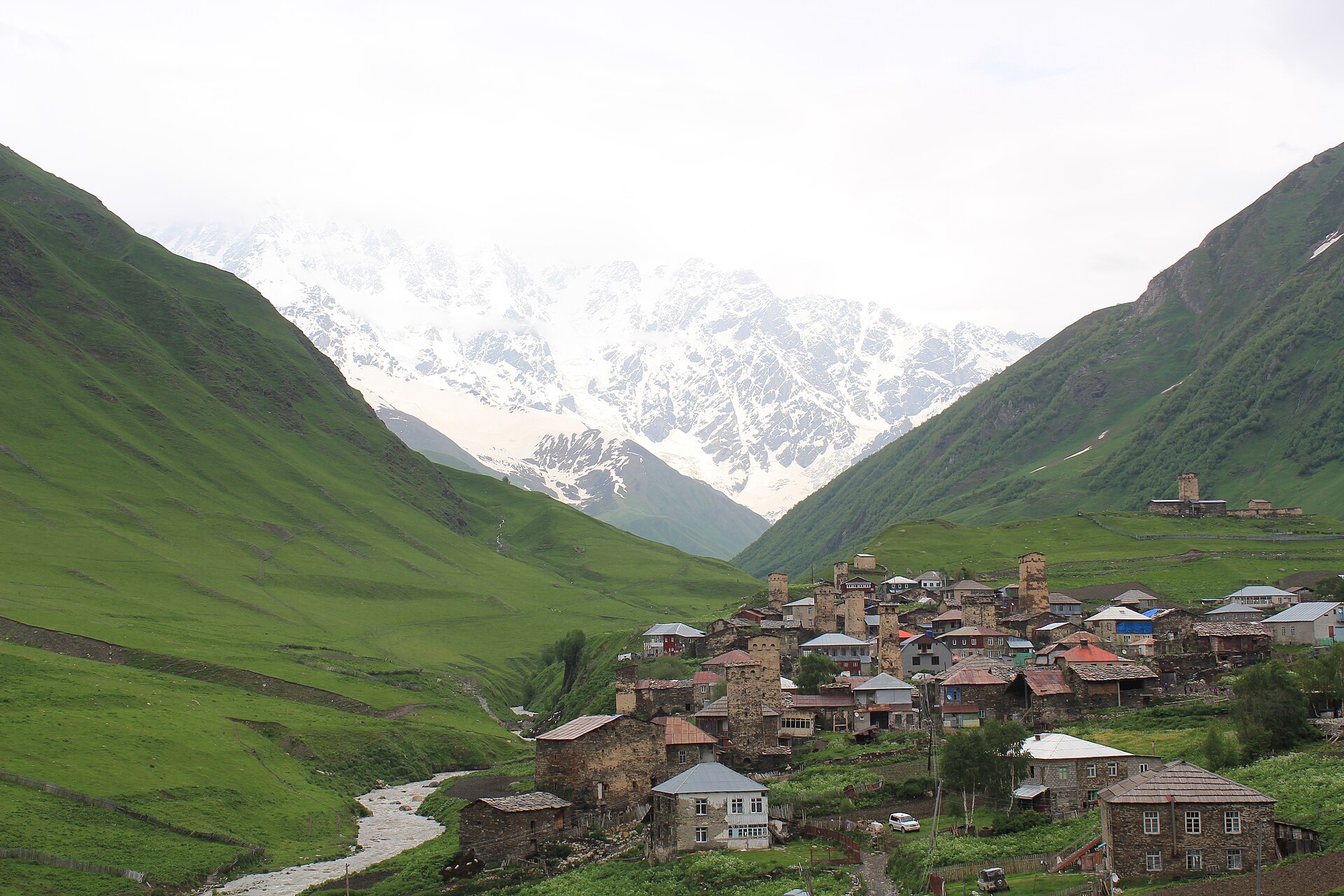
The drive is the experience as much as the village. The road follows the Enguri river, passes through Lower Bal and Becho with their own scatter of towers, then climbs the last ten kilometres to Ushguli through a valley wide enough to feel large but enclosed enough to feel held. At the top, the village itself: five clusters of stone houses and the towers above them, the Lamaria church at the upper end (12th-century, dedicated to the Virgin Mary, perched alone on the slope), and on a clear day, Shkhara — the highest peak of Georgia at 5,193 metres — closing the head of the valley.
Half a day on the ground is enough. Lunch in the village is a small selection of places that all serve roughly the same Svan menu (kubdari, the meat-stuffed bread; tashmijabi, a cheese-and-potato dish; chvishtari, cornbread with cheese). Pick whichever is open and least crowded.
The road back is the same road. Plan to be off the gravel by sunset.
Towers, not skyline
Svan architecture changes a photo brief. The dominant element is not a mountain or a church; it is a tower, specifically the Svan koshki: a tall stone defensive structure, three to five stories high, built by individual families for protection against invaders and feuding neighbours. The oldest date to the 9th century. The community of Mestia, the upper hamlets of Ushguli, and a scatter of villages in between hold roughly two hundred towers between them.
For a guest who photographs, the implication is that the strongest images are not of mountains alone or buildings alone but of the stack: tower in foreground, slate-roofed house mid-ground, peak behind. The light that makes this work is morning or late afternoon, never midday — at noon the towers look like grey shapes against grey rock.
The town of Latali, fifteen minutes from Mestia, has the best concentration of towers without the foot traffic of Ushguli. We route there for photography mornings specifically.
What goes wrong
A list of things we have managed for guests, so they do not surprise yours.
Weather. Mestia weather is its own system. Clear in the morning, hail in the afternoon, clear again by evening. This is the normal pattern, not an aberration. Pack layers; never assume the weather report from the previous day still applies.
Fuel. There is no fuel between Zugdidi and Mestia for most of the road; we refuel in Zugdidi on the way up and in Mestia for the day’s drives. The Ushguli road has no fuel at all. We carry a jerrycan when we go to Ushguli with a guest.
Signal. Cellphone signal is intermittent on the Mestia road past Khaishi and absent on most of the Ushguli road. We let our dispatch know our route and our expected times in advance; we don’t rely on phones in motion.
The driver. Long days. Eight to ten hours behind the wheel each direction, then mountain road work once in Svaneti. For trips longer than three days, we use two drivers in rotation, as any multi-day booking does. For trips with the V-Class on the gravel roads, we require a second driver as a matter of policy.
Altitude. Not high enough to be a medical issue for most guests but high enough to take some breath out of the first morning. We schedule the first day in Mestia as light: museum, lunch, walk around town, early dinner. Aggressive drives start day two.
When the V-Class handles it, and when it doesn’t
The northern route into Mestia is fine in the V-Class — the tallest car we run. The road is paved, the grades are manageable, and the height of the V-Class is helpful for the visibility through the mountain switchbacks. A V-Class can carry a group of four with luggage for a week comfortably; we use it routinely.
The Ushguli road, in the V-Class, only with caveats: dry weather only, no rain in the preceding twenty-four hours, summer months, and the second driver. In any other conditions, we transition to a 4WD vehicle for the Ushguli day, usually a Toyota Land Cruiser or equivalent, which we charter locally from a partner in Mestia. The V-Class waits in Mestia for the day.
The Zagaro Pass road from Lentekhi is not a V-Class road in any condition. If a guest insists on that route, we structure the trip in advance with a 4WD from Kutaisi and a V-Class meet at Mestia.
A four-day shape that works
The Svaneti trip that works for most guests is four days from Tbilisi:
- Day 1. Tbilisi to Kutaisi (3.5 hours), Kutaisi lunch, Kutaisi to Zugdidi (2 hours), Zugdidi overnight. Visit the Dadiani Palace in Zugdidi in the late afternoon.
- Day 2. Zugdidi to Mestia (3 hours). Museum in the afternoon. Light walk. Early dinner.
- Day 3. Mestia to Ushguli and back (full day, leaving 8am, returning by 6pm). Lunch in Ushguli. Lamaria church.
- Day 4. Mestia morning (Latali for photos), Mestia to Kutaisi to Tbilisi (long drive day). Arrive Tbilisi late evening.
Five days adds a Mestia-area day for hiking or for the smaller villages (Becho, Mazeri, the towers of Mulakhi). Six days makes room for an Anaklia or Batumi night on the way back, which guests sometimes ask for to soften the long return drive.
The booking note
Svaneti is the most logistics-heavy trip we run from Tbilisi. We confirm the route, the vehicle, the second driver, the Mestia accommodation, and the Ushguli weather window all before the trip leaves. The booking lead time is three weeks in summer, six weeks for July-August dates, and longer if a specific guesthouse is requested; the standard booking brief is the starting point.
Email bookings@soitblack.com with the dates, the size of the party, and the preferred shape (four-day standard, five-day with extra Mestia day, six-day with coastal return). We will confirm the route and vehicle within forty-eight hours. Guests who want the mountains without the four days usually take the Military Highway in shoulder season instead — or give us both options and we will compare them.