Georgia in winter is two trips that share a calendar. In the lowlands, Tbilisi, the Kakheti cellars and the Black Sea coast carry on, only colder. In the high Caucasus, some roads close for the season, and the main road north closes for hours or days at a time.
So the question for December, January or February is not whether to go, but which half of the country the trip needs.
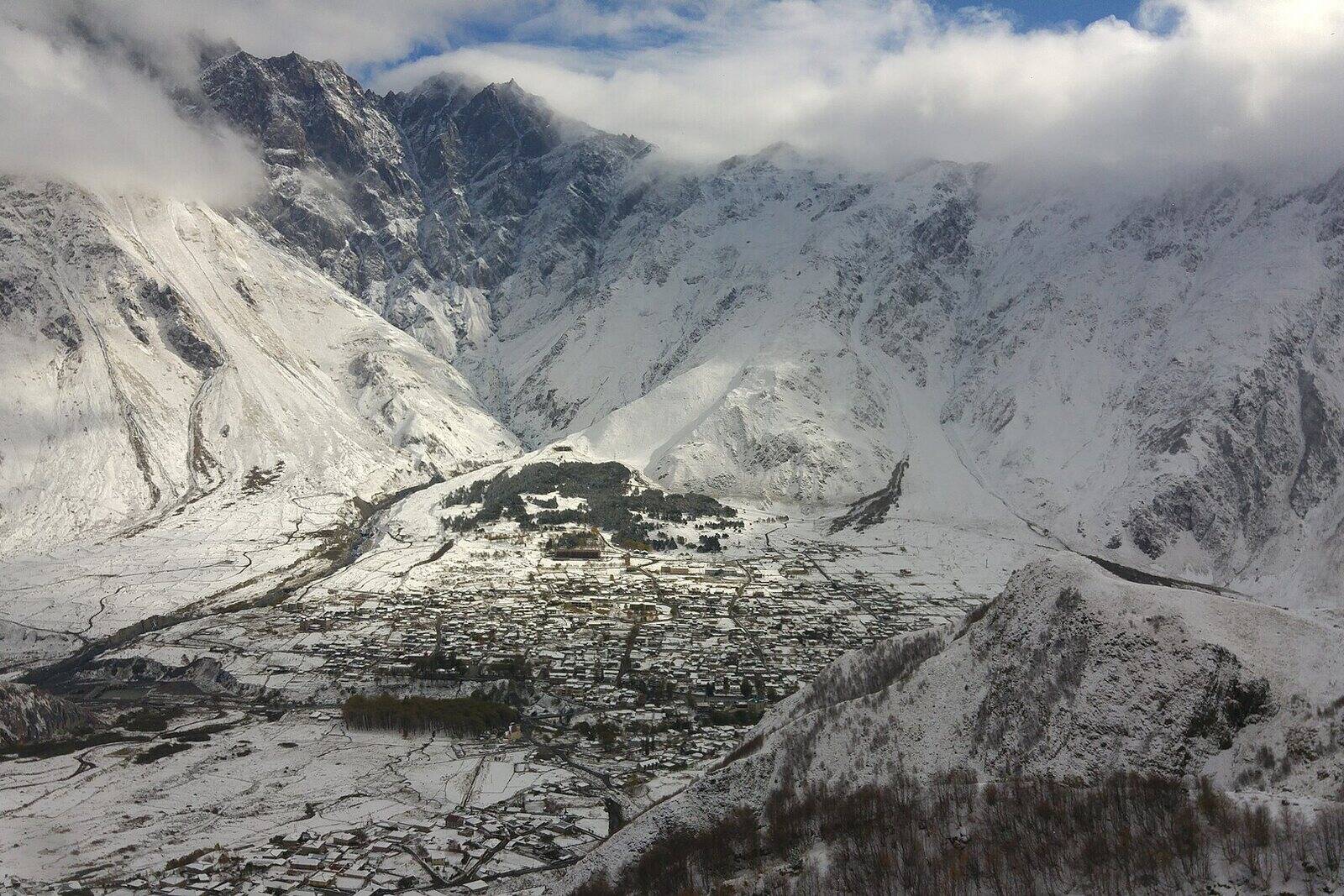 Photo: Avisadehh / Wikimedia Commons, CC0.
Tbilisi in winter, in numbers
Tbilisi in winter is cold and mostly dry. The World Meteorological Organization’s climate table for Tbilisi, supplied by Georgia’s hydrometeorological service, gives monthly means of 3.8 °C in December, 1.7 °C in January and 2.9 °C in February, averaged over 1961 to 1990. January is the driest month on that table, with 18.9 millimetres of rain over about four days.
The days are short. At the solstice the sun rises at about 08:24 and sets at about 17:33, nine hours of daylight, according to sunrise and sunset tables for Tbilisi. By the end of January sunset has moved past 18:10 and the day is ten hours long.
Is Tbilisi good in winter, then? For a city trip, yes, if the plan does not need long evenings outdoors. The sulfur baths at Abanotubani are the obvious winter hour, and the guide to the six bath houses explains how to choose one. Off-season Georgia makes the wider case for a winter trip built on Tbilisi, with day trips out.
Georgia in January has three public holidays: the Labour Code lists 1 and 2 January for the New Year, 7 January for Christmas and 19 January for Epiphany.
Day trips that work in December and January
Mtskheta is the safe one. The old capital is twenty minutes from Tbilisi by the tourism administration’s estimate, the road is not on the winter-tyre list, and a half-day in Mtskheta fits inside a short winter morning. Our hourly rate is 200 ₾ in the V-Class or S-Class and 300 ₾ in either Maybach, with a three-hour minimum.
Kakheti suits winter, because most of the day is spent indoors, in cellars and at the table. Sighnaghi is an hour and forty minutes away by the administration’s figure, on a road that is not on the tyre list; the Gombori road to Telavi is. The drive to Sighnaghi and Kakheti explains the two roads, and why the wine day is the one to be driven.
Borjomi is about two hours by road on the administration’s Borjomi page, and the S8 into its gorge is on the tyre list. It also has a train: Georgian Railway’s timetable shows a 06:35 from Tbilisi that arrives at 10:47, and a 16:30 back that reaches the capital at 20:50; check the times before travelling, because the railway does not always update that page promptly. Borjomi in a day covers the park and the water.
Kazbegi works on the days the road lets it. Stepantsminda is 2 hours 55 minutes from Tbilisi by the administration’s reckoning, but in winter the pass beyond Gudauri decides. Tbilisi to Kazbegi by car covers the price and when a night in Stepantsminda is the better plan.
The day trips from Tbilisi page sets Mtskheta, Borjomi and Kazbegi side by side, road hours against hours on the ground.
Which roads close in Georgia in winter
The Georgian Military Highway closes in pieces, not for the season. The weak section is Gudauri to Kobi, over the Cross Pass. On 13 January 2026 all traffic was suspended on it because the avalanche danger was assessed as high, while cars between Mleta and Gudauri were let through without stopping.
The Roads Department’s list of current restrictions shows how long a closure can run: shut on the afternoon of 26 February 2026, reopened to cars on 2 March, shut again on 23 April and reopened on 25 April. Gudauri itself sits at the southern end of that section, so a closure that stops Kazbegi does not always stop a Gudauri arrival. The Gudauri winter arrival describes that last climb.
Tusheti is closed for the season. The Tusheti Protected Landscape Administration says the road over the Abano pass operates only from late May to October, and that heavy snow closes it for six months, leaving the helicopter as the only way in. The Roads Department closed kilometres 22 to 72 of the Pshaveli to Omalo road on 24 October 2026; last season, high-clearance vehicles were back on the road into Omalo on 20 June. Shatili in Khevsureti keeps a similar calendar: the Korsha to Shatili section closed on 25 December 2025 and reopened to high-clearance vehicles on 9 June 2026.
Check that list on the morning of travel, not the evening before. It has an English version, and every entry is timestamped.
The ski resorts and the coast, briefly
Georgia’s tourism administration says the best months at Bakuriani, 1,700 metres up and 180 kilometres from Tbilisi, are December to March. The Bakuriani ski transfer covers that road, and Georgia’s four ski resorts compared sets it beside Gudauri, Mestia and Goderdzi.
Batumi is the mild end of the country. Adjara’s tourism department gives January an average of 7.1 °C and says snow is rare and melts quickly. It also gives the city 2,560 millimetres of precipitation a year, so this is a coast for walking in a raincoat, not for the beach.
The train is the sensible way there for a couple with light bags. It takes about four hours since Georgian Railway cut the travel time in 2026, and Tbilisi to Batumi sets it against the drive and the flight. By road, the S1 crosses two stretches on the winter-tyre list, Osiauri to Surami and the Rikoti tunnel to Tseva.
Getting around: tyres, rentals, trains and a driver
Winter tyres are the law on the listed roads from 1 December to 1 March, under Government Resolution No. 526 of 27 December 2023. A compliant tyre carries the snowflake symbol, has at least 3 millimetres of tread on a car and is no more than ten years old. In heavy snow or ice the police can require chains, and a car that does not comply can be kept off the section.
The list includes the Military Highway from Mleta to Kobi, the S8 through the Borjomi gorge, the whole road from Borjomi through Bakuriani, the Gombori road from Sasadilo to Telavi and the road to Mestia from Jvari.
The law applies to every car, rented or driven for you. At a rental desk in January, ask about the tyres and read the sidewall before signing; driving in Georgia yourself covers the licence and the insurance. For a trip that stays in Tbilisi, Kakheti and on the coast, a rented car is a reasonable choice. The trains are the cheap answer for Batumi and Borjomi, and they have no opinion about tyres.
A car with a driver is the expensive answer. Our full day is one driver for eight to nine hours, door to door: 1 350 ₾ in the seven-seat V-Class, 1 500 ₾ in the S-Class and 2 500 ₾ in either Maybach, per car rather than per guest. Kazbegi, Kakheti and Bakuriani take the whole day there and back, so they are priced at that day rate. A longer day is quoted with the extra hours included, at 135, 150 or 250 ₾ an hour depending on the car.
None of that changes what the road allows. A closed pass is closed to every car, and every fare is confirmed in writing before the car is dispatched.
For Georgia in December, January or February, send the dates, the size of the party and the places on the list to booking@soitblack.com, and the fare comes back in writing.