This is written for the person who books a business trip to Tbilisi rather than the person who takes it: the assistant or the travel desk. What to check before the ticket is issued, what happens when the flight lands after the last bus, and what a car between meetings costs.
Entry is simple for a long list of passports. One rule changed on 1 January 2026, and it is the first thing to check.
Before the ticket: visas and the insurance rule
The Ministry of Foreign Affairs list of visa-free countries names 94 countries, including every EU member state, the UK, the US, Canada, Japan and the six Gulf states, and for nearly all of them the stay allowed is a full year.
Passports that are not on it have two routes. Holders of a valid visa or residence permit from a second ministry list of countries, the US, the UK and the EU states among them, can enter for 90 days in any 180 without a Georgian visa. Most other travellers need a visa, and for a short stay the ministry points to Georgia’s e-visa portal, whose FAQ says it takes not less than five working days to make a decision on a visa application. Check both lists when booking, not from memory.
Then the change. Since 1 January 2026 every tourist entering Georgia must hold health and accident insurance, and the Law on Tourism defines a tourist as someone travelling for business, leisure or other personal purposes for at least one night. The ministry’s entry rules set the cover at no less than 30 000 ₾ for the whole stay, arrival and departure days included. The policy can come from a Georgian or a foreign insurer, on paper or electronic, in Georgian or English, and it has to be presented on entry. It belongs in the traveller’s hand, not the travel desk’s inbox.
Tbilisi keeps UTC+4 all year, without a change of clocks. The US Commerce Department’s business travel guide reports cards accepted at almost all hotels, restaurants and shops in Tbilisi, less reliably in rural areas.
Why the meeting is in Tbilisi
Georgia sells most of what it exports under free-trade terms: 87% of the total, in the Ministry of Economy’s 2024 overview of Georgia’s free trade agreements.
With the EU, the Association Agreement signed on 27 June 2014 includes a free trade area, the DCFTA, provisionally applied from 1 September 2014 and fully in force since 1 July 2016. In the European Commission’s summary of EU trade with Georgia, it removes all import duties on goods and lets EU and Georgian companies set up a subsidiary or a branch on a non-discriminatory basis.
The same overview lists an agreement with China in force since 1 January 2018. The EFTA free trade agreement with Georgia has applied to Iceland and Norway since September 2017 and to Switzerland and Liechtenstein since May 2018.
That is background, not advice. Whether any of it suits a particular company is a question for its lawyers and accountants, not its driver.
Landing after the last bus
The 337 city bus stops in front of the arrivals hall, and the airport’s page for it gives the timetable as 06:59 to 22:59 and the fare as 1 ₾, payable by bank card. For a traveller with a carry-on landing in the afternoon, the bus or a taxi is the right answer, and the airport rank charges a fixed 40 ₾ to the centre, around the clock.
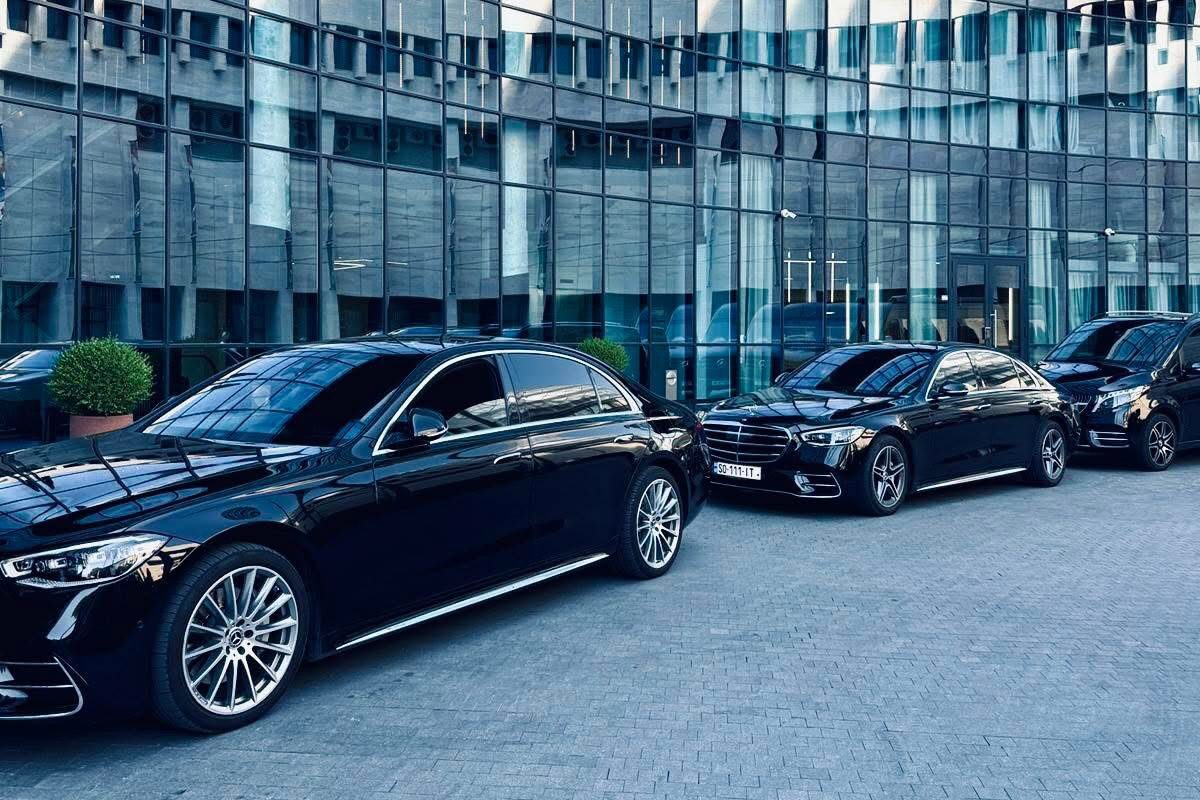
After eleven the bus has gone, and the choice is a taxi or a car booked in advance. Why a late arrival is one of the harder slots is covered in the airport playbook, and what each way into the city costs is set out fare by fare. Our airport transfer is a fixed fare: 350 ₾ in the V-Class, 500 ₾ in the S-Class and 750 ₾ in either Maybach, confirmed in writing before the car is dispatched.
The airport also sells its own arrival service, with a greeting at the gate, an escort to the baggage area and help as far as the car. When that service pays back is a short list, and a routine business arrival is rarely on it.
The working day ends at dinner
The US guide makes two points that shape a car booking. Business leaders and senior officials tend to start around ten, work into the night and often break for a late working dinner. Business lunches are less common than in the US and Europe, while the elaborate dinners known as supras are generally long, with toasts often required of the guest and wine part of any dinner.
A visitor with one meeting and a free afternoon does not need a car at all; the same guide notes the capital’s many new and inexpensive buses, taxis and marshrutka minibuses. Several addresses and a fixed end time are different. Our hourly hire is 200 ₾ an hour in the V-Class or S-Class and 300 ₾ in either Maybach, on a three-hour minimum. A full day of eight to nine hours, one driver door to door, is 1 350 ₾ in the V-Class, 1 500 ₾ in the S-Class and 2 500 ₾ in either Maybach, with extra hours at 135, 150 and 250 ₾.
At 200 ₾ an hour, seven and a half hours of S-Class hire costs the same as the day, so a schedule that starts at ten and runs into the evening is a day booking, and a dinner past the ninth hour is extra time. A three-hour gap between two meetings is the hourly minimum, 600 ₾ in the S-Class, and three hours in Tbilisi between meetings shows what fits in one. The cheaper answer to the end of a supra is a taxi back to the hotel, and it is a perfectly good one.
A company that sends people to Tbilisi more than a couple of times a year will find corporate chauffeur bookings set out on their own page. A delegation of four to seven fits in the V-Class, one of the four cars we run; the S-Class and the two Maybachs, the S-Class W223 and the EQS 680, take three guests each.
The hotel, by name and street address
Where the guest sleeps decides how long every drive between meetings takes, so choose the district before the brand. A district-by-district list of Tbilisi hotels runs from the design hotels of Vera to the corporate names, the Marriott, the Biltmore and the Radisson Blu Iveria among them, and the Tbilisi hotel pipeline follows the international brands announced for the city.
Whichever it is, put the hotel’s name and its exact street address on the booking. Names repeat: Rooms, for one, runs hotels in Tbilisi, Kazbegi and Batumi, so “Rooms” on its own is three possible destinations. Addresses repeat too: Stamba and Rooms Tbilisi share 14 Merab Kostava Street. The booking brief explains why it takes both.
Language, and what the driver is for
Georgian is the official language, and the US guide notes that English and Russian are also used and that interpreters are widely available and relatively inexpensive. A separate piece on English in Georgia covers how far it carries beyond the capital, and when a driver’s language starts to matter.
For the booking, name the language the trip needs and ask which languages the driver actually has. A negotiation that needs an interpreter should have one, booked separately, and so should a day that needs a guide. What a chauffeur does is the logistics around the meetings.
Send the flight number, the hotel’s name and street address, and the meeting schedule to booking@soitblack.com, and the fare comes back in writing before any car is dispatched.