The usual answer to why visit Georgia, the country rather than the American state, is food, wine and mountains. All three hold up. The longer answer is Georgia’s history and culture, and the practical point for a visitor is how much of it sits within a day of Tbilisi.
What follows takes the claims people repeat about the country, checks each one against its source, and names the trip that reaches it. Most survive. A few need a qualifier, and the qualifier is usually the more interesting part.
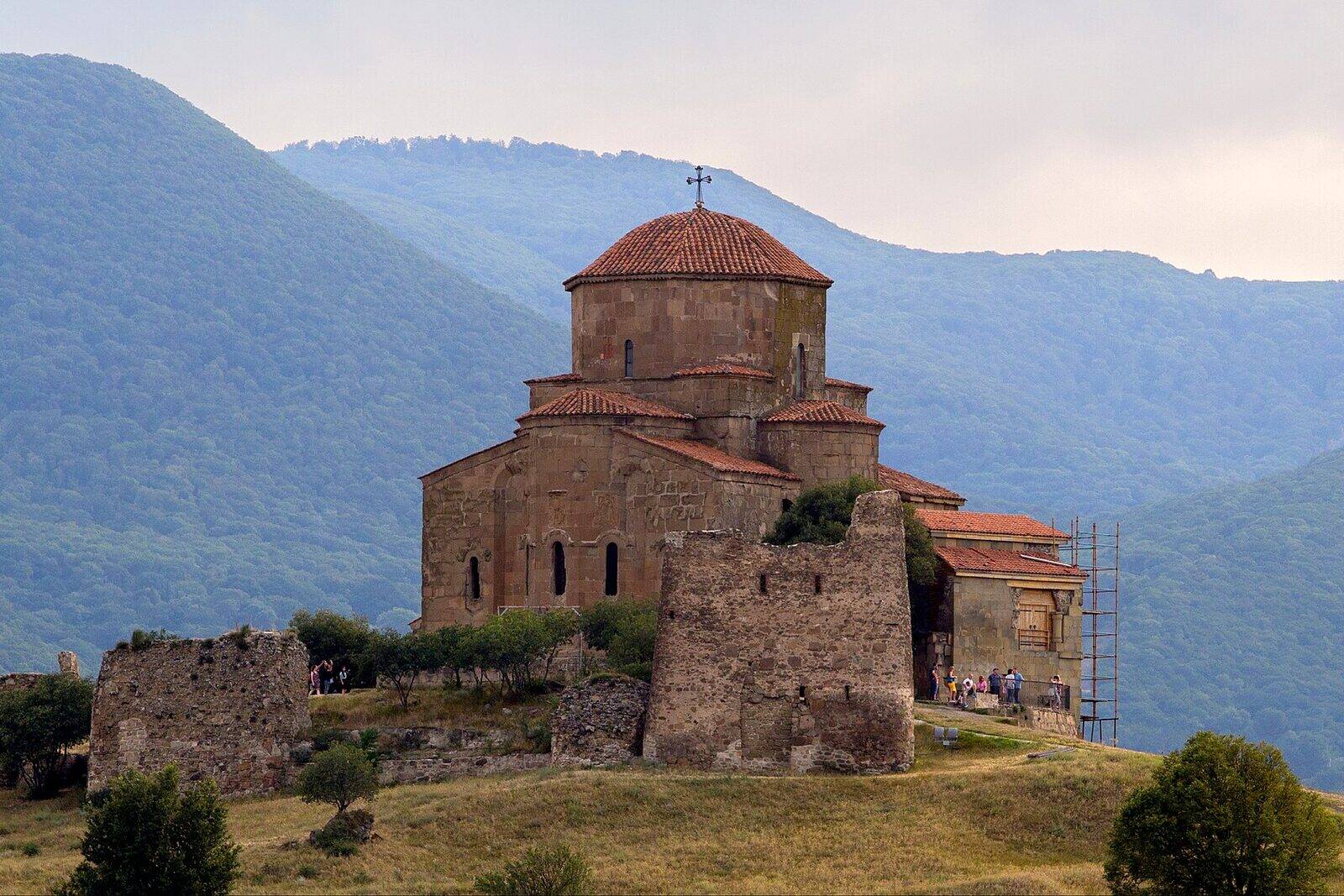 Photo: Jon Gudorf Photography / Wikimedia Commons, CC BY-SA 2.0.
Wine, and what the 8,000 years means
The number comes from a 2017 paper in the Proceedings of the National Academy of Sciences. Its authors analysed residue absorbed into pottery from two Neolithic sites, Gadachrili Gora and Shulaveris Gora, roughly 50 kilometres south of Tbilisi in the province of Kvemo Kartli. They reported the earliest biomolecular archaeological evidence for grape wine from the Near East, dated to about 6000 to 5800 BC.
Two qualifiers are worth keeping. The paper’s claim is limited to the Near East, and its jars are not qvevri: the same paper dates the earliest archaeological evidence for qvevri winemaking in Georgia to the Iron Age, the eighth to seventh centuries BC. The honest version of “the oldest wine in the world” is narrower, and more interesting for it.
The qvevri is the part still in use. UNESCO added the method to its intangible heritage list in 2013: juice, skins, stalks and pips sealed in an egg-shaped clay vessel and buried in the ground to ferment for five to six months. The same listing calls the wine cellar the holiest place in the family home, which is a useful sentence to have read before walking into one.
The Alaverdi Monastery cellar is the stop for the history, and the wine roads of Kakheti cover the cellars that pour it. Nobody who has been tasting since eleven should drive back, which is the whole case for a Kakheti day with a chauffeur.
Dmanisi, long before any of it
The same province holds a find of a different order. In its guide to Georgian archaeology, the national tourism administration calls Dmanisi “the oldest hominid settlement in Europe”. The Smithsonian’s Human Origins Program is more careful: it dates a skull from the site to about 1.77 million years and calls it one of the earliest skulls known outside of Africa. Another Dmanisi skull belonged to an old man who lost most of his teeth long before he died. His group must have looked after him, and the Smithsonian counts that as some of the earliest known evidence of this kind of care in the human fossil record.
The faces, at least, do not need a car. The same tourism guide notes that reconstructions of a man and a woman from Dmanisi, named Zezva and Mzia, are on display at the Simon Janashia Museum of Georgia on Rustaveli Avenue. The site itself, a museum-reserve that also holds the ruins of a medieval town, is a separate drive into Kvemo Kartli.
Mtskheta and the fourth century
Mtskheta is the half day that explains the rest of the week. UNESCO’s listing for the Historical Monuments of Mtskheta describes the town as the capital of Kartli, the eastern Georgian kingdom, from the third century BC, and as the place where Christianity was proclaimed the official religion of Georgia in 337. Its churches have been a World Heritage site since 1994.
Two of them carry the visit: Jvari, the sixth-century church on the hill, and Svetitskhoveli, the eleventh-century cathedral in town. A half-day in Mtskheta sets out the order to see them in. At about twenty minutes north of the city, longer in traffic, it is the only genuine half day among our day trips from Tbilisi. That makes it hourly hire rather than a day rate, and for anyone who would rather not book a car at all, a taxi does the job.
The story has a Tbilisi end. By legend, Saint Nino, who preached Christianity in Georgia in the fourth century, was given a cross of grapevine, and that cross is now displayed at Sioni Cathedral. Wine and faith, in other words, share a relic. Sioni is one end of the old-town walk, which needs no car either.
Georgia’s history and culture, still in daily use
Two more UNESCO listings for Georgian culture are not places at all. The first is the script. Georgian is written in three alphabets, Mrgvlovani, Nuskhuri and Mkhedruli, and their living culture joined UNESCO’s intangible heritage list in 2016. Mkhedruli is the script taught in schools and passed on at home. The older two live on mainly in the church: psalms, hymns, the lettering on icons.
The second is the singing. Georgian polyphonic singing was proclaimed a UNESCO masterpiece in 2001 and inscribed on the list in 2008. The listing maps it by region: complex polyphony in Svaneti, a dialogue of voices over a bass in Kakheti, three partly improvised parts in western Georgia. Some of the songs, it adds, are linked to the cult of the grapevine.
Georgia’s own heritage agency added one more in 2017, giving the tradition of feasting and toasting national heritage status, which says something about how seriously the long table is taken.
The golden age, west and south
UNESCO’s entry for Gelati places it in the “golden age” of medieval Georgia, a period of political strength and economic growth between the reigns of King David IV, the Builder, and Queen Tamar. Each end of that age is a long day from Tbilisi.
David began Gelati in 1106, near his capital at Kutaisi. The main church was finished in 1130, and its apse holds a twelfth-century mosaic of the Virgin and Child flanked by archangels. Gelati also housed an academy, which UNESCO counts among the most important centres of culture in ancient Georgia. Kutaisi in a long day covers the road and what fits around it.
Tamar’s end is the rock-cut monastery of Vardzia, reached by a valley road along the Mtkvari. Georgia Today’s history of the site dates its first intensive building to the reign of Giorgi III and its Church of the Dormition to 1186, under Tamar. On the church’s north wall, both rulers hold models of it. Vardzia from Tbilisi is a genuine long day.
Both are whole days out and back, so we price them at the day rate: 1 350 ₾ in the V-Class, 1 500 ₾ in the S-Class and 2 500 ₾ in either Maybach. These two routes run past a standard day, so the quote includes the extra hours, and the fare is confirmed in writing before the car is dispatched.
Svaneti, which will not fit in a day
Upper Svaneti has been on the World Heritage List since 1996. UNESCO’s Upper Svaneti listing says the region was preserved by its long isolation, and describes tower-houses used both as dwellings and as defence posts against the invaders who plagued the region.
It is the one place in this piece that cannot be reached from Tbilisi and back in a day. Svaneti by road sets out the routes in, and we quote it as a multi-day booking, in writing and in advance. If the mountains have to fit inside one day, Kazbegi from Tbilisi is the trip that does.
A car gets a party to the door; the history inside is a guide’s work, and a guide is a separate booking. Send the list of places to booking@soitblack.com and the fare comes back in writing before any car is dispatched.